
In this article
- 1Who visits an agri company website
- 2Examples from our work
- 3Must-have sections
- 4Kannada and regional language content
- 5WhatsApp support for farmers
- 6Compliance and responsible claims
- 7Mobile speed and usability
- 8Search and visibility
- 9Common mistakes to avoid
- 10What shapes the effort
- 11How JST Click can help
Crop nutrition and agri-input companies have a unique audience. Your website has to work for a farmer checking which product suits their tomato crop, a dealer looking to stock your range, a distributor in another state, and sometimes a government or institutional buyer. Many of these visitors are on a mobile phone, on a patchy network, and more comfortable in Kannada than in English.
This guide covers agriculture company website development for fertiliser, micronutrient, bio-stimulant and other agri-input businesses: what to include, how to structure product and crop information, and how to turn visitors into dealer and farmer enquiries.
Who visits an agri company website
| Visitor | What they want | What helps them |
|---|---|---|
| Farmer | Right product for my crop and problem | Crop-wise pages, dosage, photos, WhatsApp, nearest dealer |
| Dealer or retailer | Margins, range, support, how to stock | Dealer enquiry form, product catalogue, brochures |
| Distributor | Territory, company credibility | About page, certifications, contact for business |
| Agronomist or institution | Technical details | Composition, approvals, technical sheets |
| Job seeker | Field roles | Careers page |
Designing for the farmer first, and the dealer second, usually gives the best result.
Examples from our work
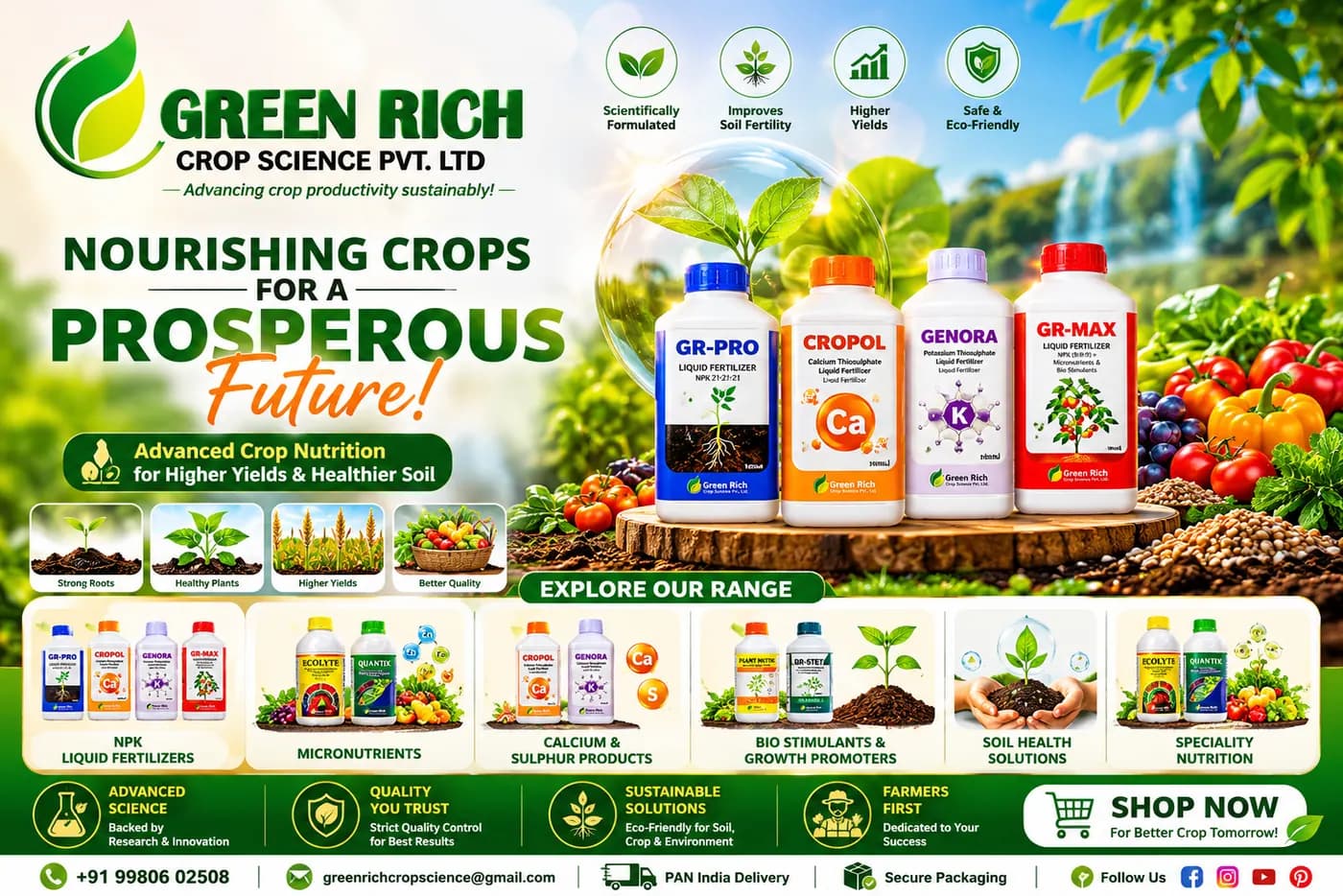
JST Click has built websites for agri-input businesses, including:
- Green Rich Crop Science — Crop nutrition and agri products
- GreenR — Organic crop nutrition products
You can see them in our work.
Must-have sections
1. Product catalogue
Each product should have its own page with:
- Product name, pack sizes and clear pack photos
- Category — for example water-soluble fertiliser, micronutrient, bio-stimulant, organic input
- Composition as stated on the label
- Recommended crops
- Dosage, method and stage of application in a simple table
- Downloadable leaflet or technical sheet (PDF)
- A "Find a dealer" and WhatsApp button
Filters by crop, category and problem (for example flowering, fruit size, deficiency symptoms) help farmers find the right product quickly.
2. Crop-wise pages
Farmers think in terms of crops, not product codes. A page for each major crop — paddy, sugarcane, tomato, chilli, grapes, banana, arecanut, coffee and others relevant to your region — can show:
- Stages of the crop
- Which of your products are recommended at each stage
- Dosage and timing
- Photos of the crop stages
This is also valuable for search, since farmers and dealers often search by crop name.
3. Dealer locator
A dealer locator is one of the most used features on an agri website.
- Search by district, taluk or pin code
- Use current location to show the nearest dealers
- Each dealer listing with name, address, phone and map directions
- Admin panel for your team to add, edit or hide dealers
4. Dealer and distributor enquiry
A separate form for business enquiries:
- Name, shop or firm name, district, phone
- Current brands stocked and interest area
- GST number (optional)
- Enquiries sent to your sales team by email and WhatsApp, and stored in an admin list or a simple CRM
5. About, quality and approvals
- Company story, manufacturing or sourcing
- Quality process
- Registrations and certifications you actually hold
- Photos of your facility and field team
Kannada and regional language content
If most of your farmers are in Karnataka, Kannada content is not optional. Plan it properly:
- A language switch at the top of every page
- Kannada versions of product pages, crop pages and contact details at minimum
- Translations checked by someone who knows farming terms, not just a general translator
- Proper Kannada fonts that render well on budget phones
- Separate URLs for each language so search engines can index both
| Approach | Good for | Watch out for |
|---|---|---|
| English only | Companies selling mainly to institutions or other states | Excludes many farmers |
| English + Kannada | Karnataka-focused brands | Every update needs two versions |
| English + several Indian languages | Multi-state distribution | Higher content and review effort |
WhatsApp support for farmers
For many farmers, WhatsApp is easier than any form.
- A click-to-chat button on every product and crop page
- Pre-filled messages such as "I want to know about [product] for my crop"
- Encourage farmers to send photos of the crop problem
- Use WhatsApp Business quick replies for common questions
- Route chats by region if you have field staff in different districts
Make sure your team can respond in Kannada and within working hours, and show those hours clearly.
Compliance and responsible claims
Fertilisers, bio-stimulants and other agri inputs are regulated in India, and labels usually carry approved details. On your website:
- Keep composition, dosage and crop recommendations consistent with your label and approvals
- Avoid yield guarantees or claims you cannot support
- Show safety and storage instructions where relevant
- Check current regulations for your product category with your regulatory advisor before publishing new claims
Mobile speed and usability
- Pages should load quickly on 4G or weaker networks
- Compress images and avoid heavy animations
- Large buttons for Call, WhatsApp and Directions
- Simple navigation: Products, Crops, Find a Dealer, Contact
Search and visibility
- Crop-wise pages targeting searches like "fertiliser for tomato flowering"
- Product pages with clear titles and descriptions
- A Google Business Profile for your office and factory
- Kannada pages indexed separately
Our SEO services can help you build this visibility once the site is live.
Common mistakes to avoid
- Listing products by code only — farmers search by crop and problem, so name and group products the way they talk about them.
- Outdated dealer lists — a farmer who calls a closed shop will not trust the site again. Assign someone to review the list every month.
- Heavy PDF-only catalogues — keep key details on the web page itself and offer the PDF as an extra.
- Ignoring enquiries — a dealer form that nobody answers for a week is worse than no form. Decide who owns each enquiry before launch.
- English-only crop advice for a Kannada-speaking audience.
What shapes the effort
- Number of products and crops
- Number of languages
- Dealer locator size and how often it changes
- Enquiry handling — email only, or a CRM
- Online ordering for dealers, if needed
- Content: photos, crop guides and translations
How JST Click can help
JST Click is a website, app and software development company in J. P. Nagar, Bengaluru. We have built websites for crop nutrition companies, including Green Rich Crop Science and GreenR, and understand that an agri website has to serve farmers and dealers at the same time.
We help you structure products by crop, set up a dealer locator your team can update, add Kannada content and connect WhatsApp for farmer queries. Explore our website development services, browse our work, or get a free consultation.
Frequently asked questions
Should an agri-input company sell products directly on its website?
Not always. Many crop nutrition companies sell through dealers and distributors, so the website focuses on product information, a dealer locator and enquiries. Direct online sales can be added later if your distribution model and regulations allow it.
How should crop and dosage information be shown?
Show each product's recommended crops, dosage, method and timing of application in a clear table, matching what is approved and printed on your label. Avoid adding claims on the website that go beyond your label and approvals.
Do I need a Kannada version of my website?
If your farmers and dealers are mainly in Karnataka, Kannada pages for products, crop guides and contact details make the site much easier to use. English pages still help with distributors, institutions and buyers from other states.
How does a dealer locator work?
Your team adds dealers with their name, address, district, taluk, phone and map location from the admin panel. Farmers search by district or pin code, or use their current location, and can call the dealer or open directions in Google Maps.
Can farmers contact us on WhatsApp from the website?
Yes. A WhatsApp button on every product and crop page lets farmers send a question, a photo of their crop or a request for the nearest dealer. A WhatsApp Business account helps your team manage these chats.
- Agriculture
- Website Development
- Dealer Network
- Kannada
- Our Projects

Written by
JST Click Team
We design and build websites, mobile apps and software for businesses from our office in J. P. Nagar, Bengaluru, and write these guides from what we see on real projects.